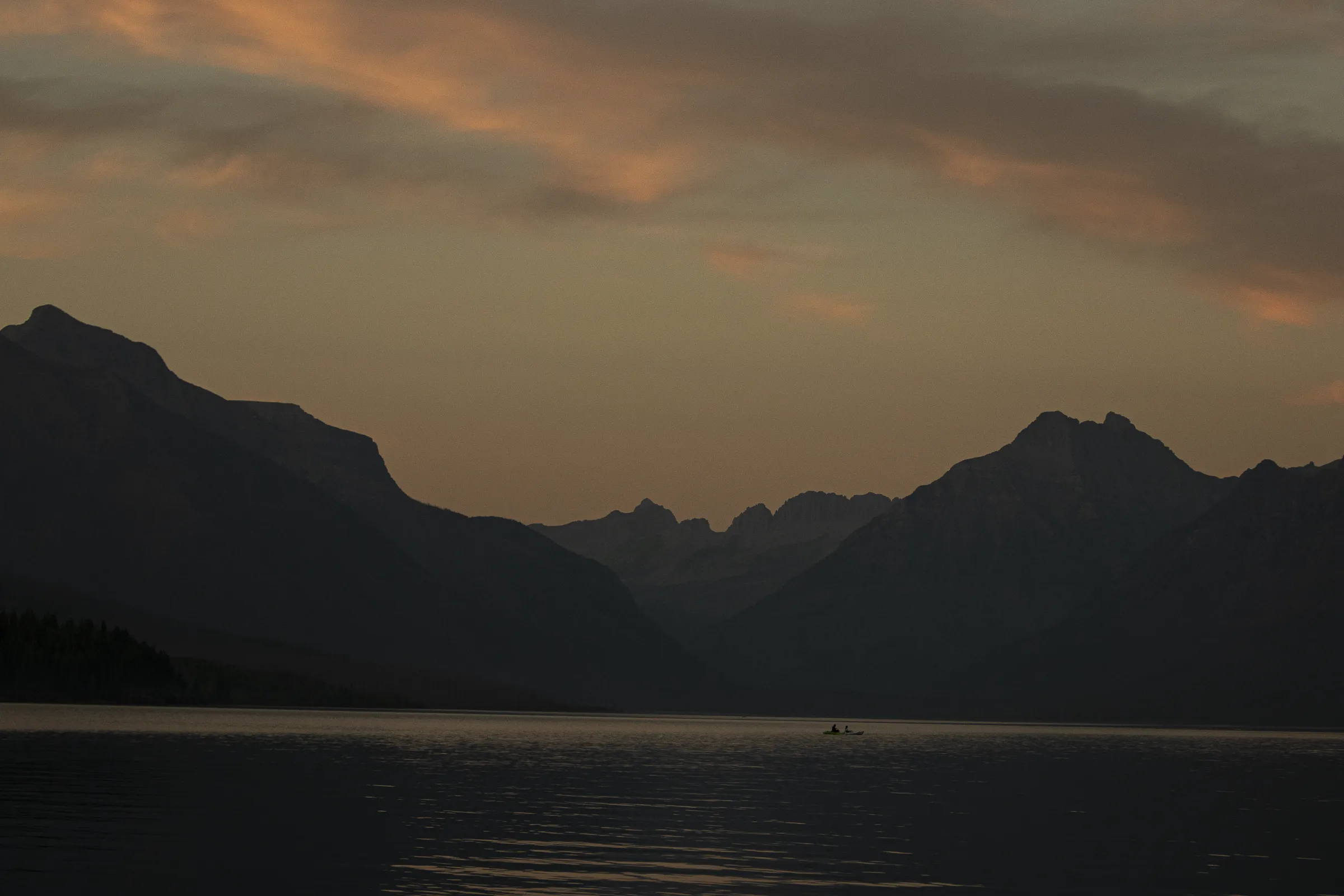
Lake McDonald is the largest lake in Glacier National Park, Montana, at 1,285 metres. It is a long, narrow, glacially carved lake running roughly northeast to southwest in a steep valley, with the Going-to-the-Sun Road following its eastern shore.
What drives the score here
McDonald is cold-water territory. The lake is deep and fed by cold mountain drainage, so water temperature holds the score down well past the point where the air has warmed up — the same pattern as Lake Crescent, at four times the elevation. Its shape matters as much as its depth: a long, narrow basin aligned with the valley gives wind a straight run when it lines up with that axis, and much less when it does not. That makes McDonald’s wind behaviour more directional than at the broad open reservoirs.
What the Paddle Score measures
A single number from 1 (Danger) to 5 (Excellent), built from wind speed and gusts, air and water temperature, UV index, cloud cover, precipitation and visibility — then constrained by fixed safety rules the model is not allowed to override. Wind above 25 mph costs two full points. Water below 5°C is penalised hard regardless of how good the day looks.
What the score can’t see
Glacier sits far enough north that the usable season is short, and shoulder-season conditions move quickly. Park road and access status is an entirely separate question from the weather, and one the Paddle Score does not answer — check the National Park Service for current conditions.
Wear a life jacket, every time. The Paddle Score is a decision aid, not clearance to go out. It cannot account for your skill, your equipment, currents, traffic, or hazards at your launch site.