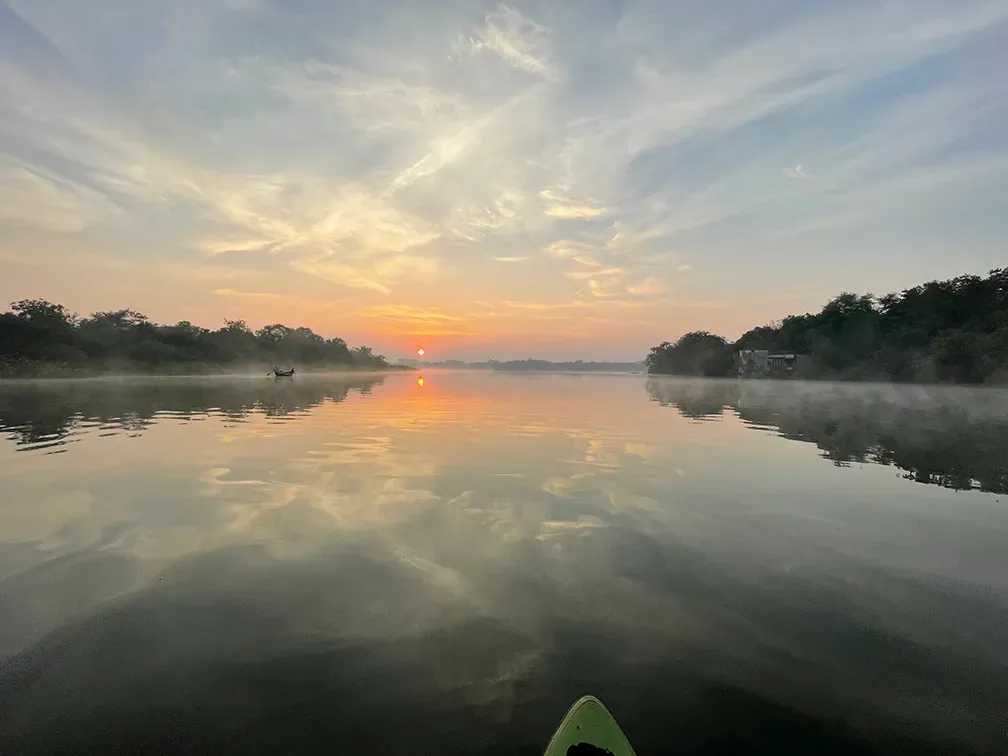
Ambazari is an urban lake on the western edge of Nagpur, in Maharashtra, and the only spot in this list outside the United States. It sits at roughly 330 metres above sea level, ringed by the city rather than by wilderness. Paddle far enough out and the traffic noise drops away and you are mostly surrounded by birds.
What drives the score here
Ambazari is the warmest location Kaayko tracks, and that changes which input decides the score. The cold-water penalty that dominates the alpine reservoirs almost never fires here. Instead the score is usually set by heat, UV, and wind — and during the monsoon months, by rain and reduced visibility. When Ambazari scores badly, it is far more often a heat-and-UV problem than a cold-water one. It is also the spot where the seasonal swing in what limits the score is widest, because the monsoon changes the dominant input outright rather than shifting it by degrees.
What the Paddle Score measures
A single number from 1 (Danger) to 5 (Excellent), built from wind speed and gusts, air and water temperature, UV index, cloud cover, precipitation and visibility — then constrained by fixed safety rules the model is not allowed to override. Wind above 25 mph costs two full points. Water below 5°C is penalised hard regardless of how good the day looks.
What the score can’t see
This is a city lake, which is exactly the case the model handles worst. Local rules, access, and water quality change more quickly than any weather feed can track, and none of that is visible to the score. Ambazari is also the one location here where I would treat the forecast as the least authoritative part of your planning, not the most.
Wear a life jacket, every time. The Paddle Score is a decision aid, not clearance to go out. It cannot account for your skill, your equipment, currents, traffic, or hazards at your launch site.